Hay Market
Crime and PunishmentThe Hay Market is a crowded commercial quarter of Saint Petersburg whose everyday bustle makes it a refuge from scrutiny for Rodion Romanovitch Raskolnikov. It is both a real social environment, marked by trade, poverty, and crowded streets, and the setting of an apparently chance encounter that gives Raskolnikov precise information about Alyona Ivanovna’s movements. The market’s ordinary rhythms—merchants packing up, customers going home, and acquaintances talking at street corners—become inseparable from the course of his intended crime.
Setting and social character
Situated near streets and alleys crowded with trading and working people, the Hay Market lies amid numerous establishments of bad character. Its population and activity are so varied that even an unusually strange figure attracts little notice. Raskolnikov’s clothes are in rags, but in this part of the city shabby dress is not an exceptional spectacle. The setting therefore offers a contrast with the shame he might feel elsewhere: his bitterness and contempt leave him especially indifferent to how he looks in the street, while encounters with acquaintances and former fellow students still trouble him.
The market’s relative anonymity matters to him. When he wanders aimlessly, he likes the Hay Market and its neighboring alleys because his appearance does not draw contemptuous attention there, and people can walk about in any attire without scandal. The place does not remove his poverty; it changes how visible and consequential that poverty feels. In a district where many kinds of hardship and behavior coexist, his rags are absorbed into the surrounding variety.
The market in its daily rhythm
At about nine in the evening, the market is closing. People at tables, barrows, booths, and shops pack away their wares and prepare to go home alongside their customers. Rag pickers and costermongers crowd near taverns in the market’s dirty courtyards. This is not an empty or secluded setting: its activity gives the encounter that follows the character of public, ordinary conversation amid the dispersal of the day’s trade.
At the corner of an alley, a huckster and his wife have tables laid out with small goods, including tapes, thread, and cotton handkerchiefs. They are lingering with a friend rather than simply closing up. The specificity of the goods and the hour grounds the decisive news in routine commerce: the information reaches Raskolnikov not through a deliberate inquiry, but while he is passing through a familiar district as its sellers are getting ready to leave.
An overheard conversation
The friend is Lizaveta Ivanovna, the younger sister of the old pawnbroker Alyona Ivanovna. Raskolnikov already knows about Lizaveta, and she knows him a little. She is about thirty-five, tall, clumsy, timid, and submissive; she lives in fear of her sister, who makes her work day and night and beats her. At the market she stands with a bundle, listening earnestly and uncertainly while the huckster and his wife urge her to make up her mind and come the following day around seven. The wife adds that they will have tea. Lizaveta agrees, still pondering, and slowly moves away.
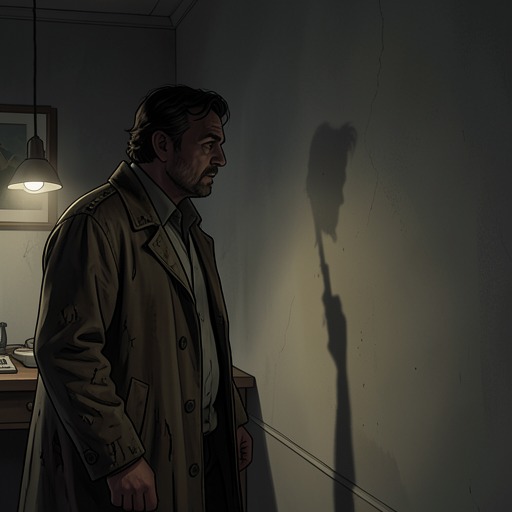
Raskolnikov has just passed the group. He walks softly and unnoticed, trying not to miss what is said. At first the sight of Lizaveta has astonished him; then, as he hears the conversation, astonishment gives way to horror. He understands that Lizaveta will be away from home at seven the next evening and that Alyona, her sister and only companion, will consequently be alone. The details supplied in an incidental exchange—who will leave, when she will leave, and who will remain—give him unusually exact information without the risk of asking questions or making inquiries.
Chance, decision, and narrative significance
The encounter happens because Raskolnikov has returned by way of the Hay Market despite being tired and having no need to take that route. He later remembers that he could have gone home by the shortest, most direct way, and that wandering without noticing his route had happened to him many times before. Precisely because the detour is unnecessary, he comes to regard this particular meeting as a predestined turning point in his fate: chance seems to have placed the information before him at the moment it can exert the gravest influence.
The market’s public bustle thus produces a stark inward reversal. Only a few steps from his lodging, Raskolnikov feels as if he is going in like a man condemned to death; he cannot think and believes that his freedom of thought and will have vanished. At the same time, he recognizes the practical advantage of what he has learned: the next day at a precise hour, Alyona will be home alone, and he has obtained that knowledge without dangerous investigation. The Hay Market does not itself decide what he will do, but its everyday chance meeting transforms an abstract plan into an opportunity whose apparent certainty bears down on him as an irrevocable decision.